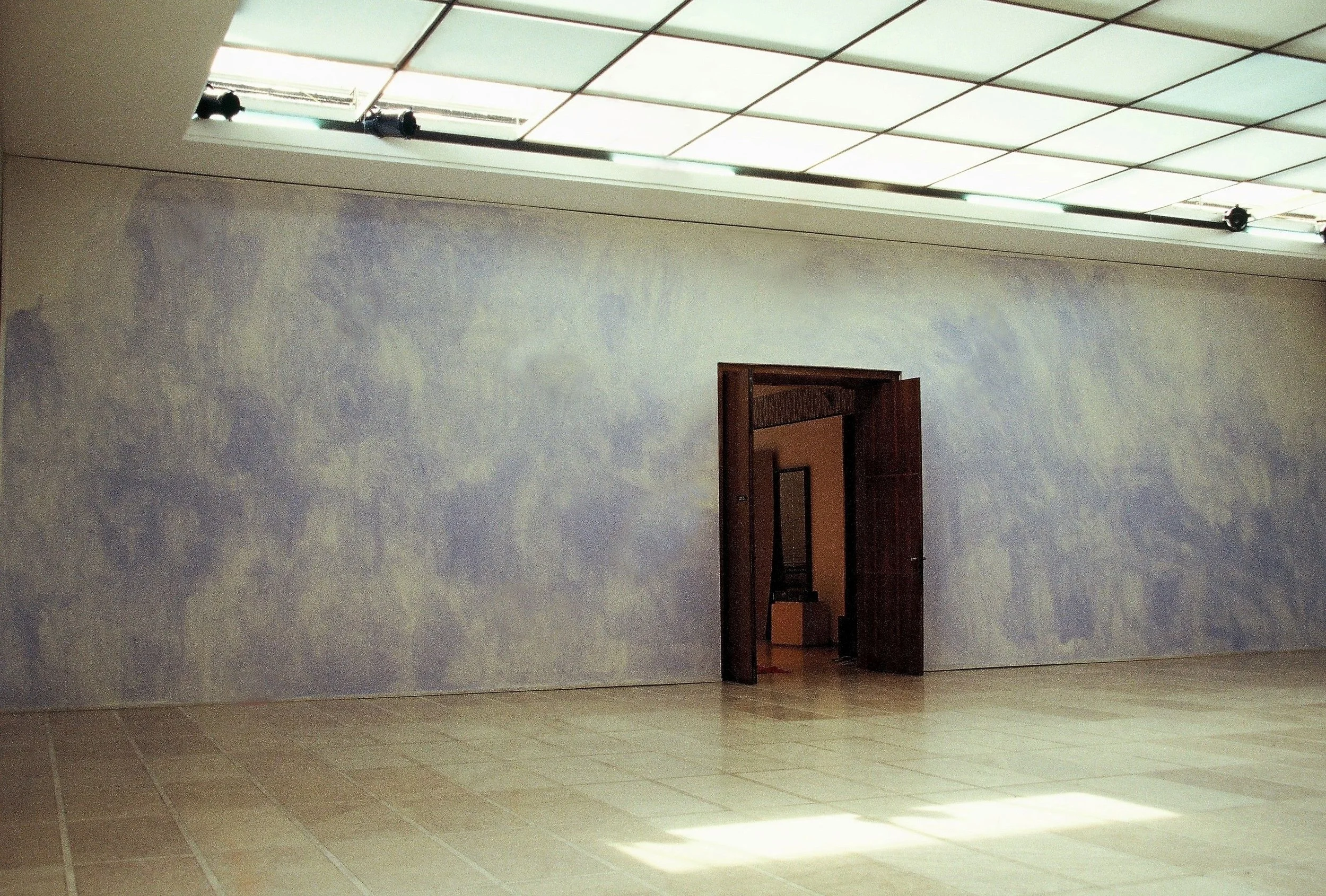
Philipp Haager, Jovana Popić, Sky, wall painting, 2001, ca 5m x 20m, pigments and emulsion on canvas, Museum of Yugoslavia
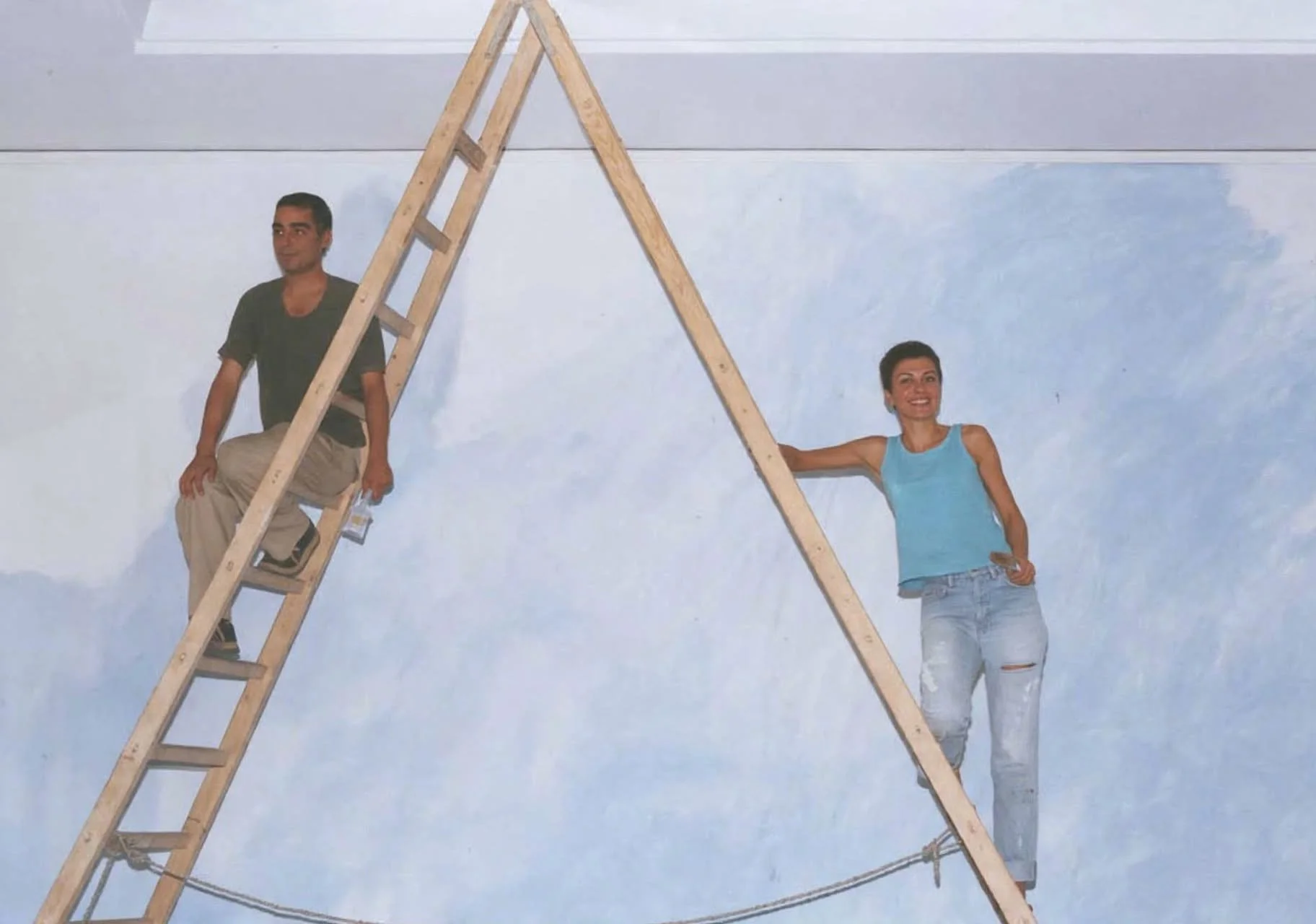
Philipp Haager’s ethereal sky renderings and the deconstructive interventions of his contemporaries redefine the boundaries of shared space and universal horizons.
(…) Philipp Haager’s subject matter is the sky, and his current paintings are incredible renderings of that impalpable, ever-changing, yet universal horizon. “Sky” was a huge wall painting he realised in 2001 together with Jovana Popić. It emanated a sense of lightness and positivity, which only blue, cloudless sky can do, as did his “shampoo-paintings”, which dripped and spread over the museum’s windows, acting as filters that coloured the view of the landscape outside with the most incredible shades of blue and green, as synthetic and acid as shampoo colours can be. (…)
from: Real Presence Book, by Dobrila Denegri & Biljana Tomić, 2019, p 36
images: Philipp Haager, Jovana Popić,“Sky”, wall painting, 2001, Museum of Yugoslavia, ibid p 109
“What gives us hope and motivates us to make a fresh start,
is perhaps connected with the view up into that sky”
under one sky
A look back at the temporary mural painting at the May 25 Museum (today the Museum of Yugoslavia) by Jovana Popic and Philipp Haager for the exhibition Real Presence 2001.
In the immediate neighbourhood of the Belgrade museum there were many conspicuous traces on the cityscape of the destruction wrought by the NATO air raids and bombings of 1999. In this hotly contested city with its once grand history, this spot seemed like an emblematic culmination of all those tragic, brutal and – in a peculiar way – also absurd moments experienced by a Europe in the throes of upheaval.
The past decades of civil war in the Balkans had been tragically and unspeakably horrific, with the genocide in Kosovo and the participation of a German Labour/Green Government in a NATO act of aggression led by the USA that could only be seen as absurd – at least by contemporaries.
The mood among many of the students participating in the workshop was accordingly charged and volatile. A karma of despair left over by the recent events – and also a feeling of aggression – lay in the air. This was already noticeable during the first days of the two-week workshop in the many performances by students from Marina Abramovic’s class at Braunschweig University of Art, as well as in the paintings, prints, and photographs that gradually filled the walls of the museum, some of them depicting fighter jets, rockets, the then US President Bush and Pope John Paul II.
On the upper floor of the May 25 Museum (also formerly known as the Tito Museum), in the entrance hall, opposite a wall relief depicting a world map (but omitting the southern tip of Africa), there was a large white canvas screen with a portal in its centre. The canvas was stretched in front of a wall to conceal older murals and reliefs behind it.
Through the portal one could catch a glimpse of windows onto a terrace, before which armed soldiers in camouflage uniforms paraded back and forth on patrol. Here, adjacent to the museum grounds – so it was said – was the office of former president Milošević, where his wife could still be found, while he himself was at the time already appearing before a war crimes tribunal in The Hague.
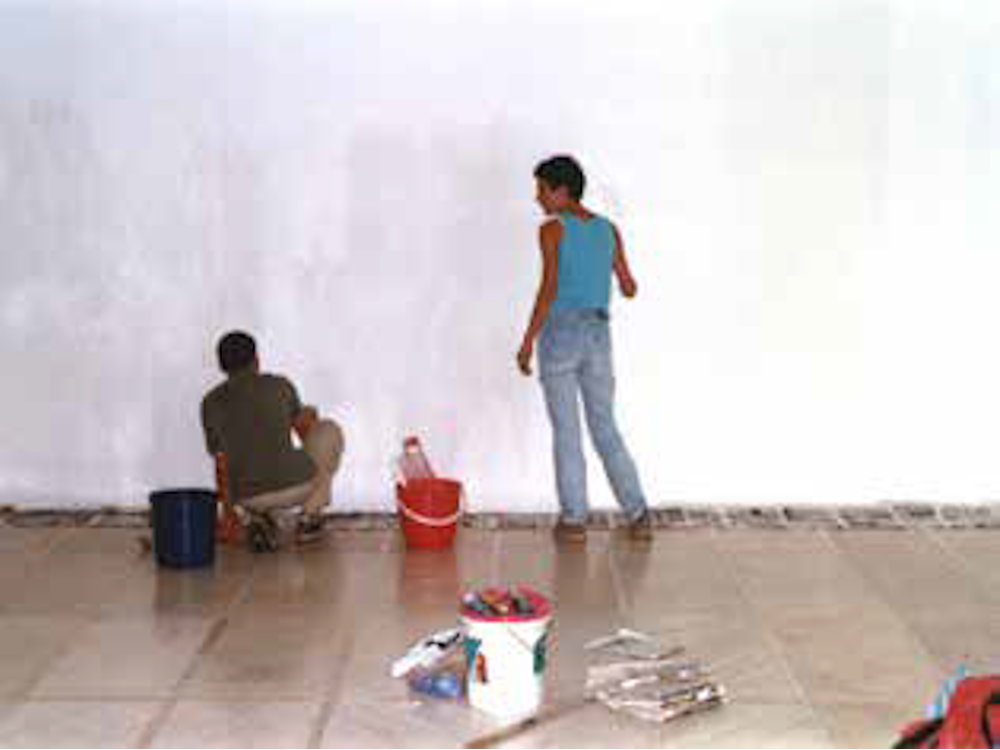
Jovana Popic, a painter from Croatia who was studying painting in Belgrade, painted a mural alongside me. We used white and ultramarine pigments, mixed directly into the still damp but rapidly drying emulsion paint on the wall, similar to the procedure used in the fresco paintings that we both so loved and admired.
With our painting, which could be read as a sky above the world that was visible opposite, we wanted to come up with a kind of symbol, for a belief, and perhaps also a signal. What unites us all – among many other things, of course – might include our gaze into a sky that arches above all of us, which is blue, white, cloudy, flooded with light or overcast for everyone – and much of what moves us humans, what gives us hope, motivates us to make a fresh start, is perhaps connected with a view upward into that sky.
I returned from Belgrade with these two weeks of encounters and experiences on my mind – some of them not the best due to personal circumstances – on 11 September 2001. Upon my arrival at Frankfurt Central Station, an airplane crashed into one of the twin towers of the World Trade Center in New York on the huge video monitors above the platforms and exploded on camera before the eyes of nearly the whole world.
From today’s viewpoint, this sequence of images seems both tragic and exemplary of the dilemma of that time, within our own generation, whose members included the majority of the students from all over Europe who were participating in the workshop. In this terrorist attack, which changed the world profoundly with effects that can still be felt keenly today, even the view into the sky was besieged and used for terror, horror and death – a different “Real Presence” than what was meant by the title of the workshop – and the world suddenly seemed very far away from the mission of exchange, understanding and peace that we had tried to launch in our very modest way.
P. H., July 2018
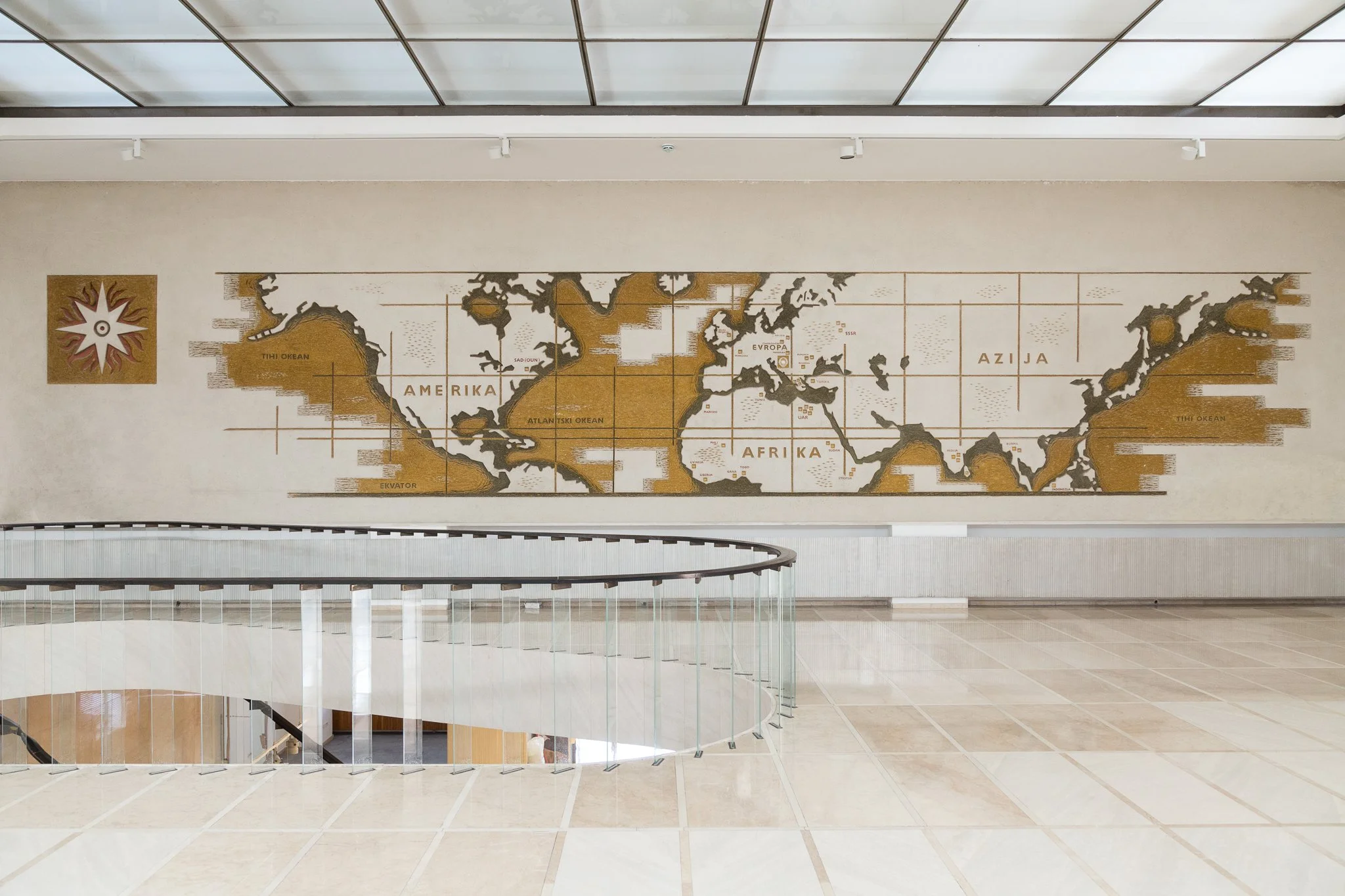
Museum of Yugoslavia. (o. D.). World Map Showing Tito's Travels [foto]. Retrieved September 2026 von https://muzej-jugoslavije.org/